Over the course of my Ph.D., I've mainly worked on improving our understanding of clouds. Clouds are a hot topic in climate science right now because they are the most uncertain part of our current climate forecasts.1 The reason is that they interact strongly with radiation and therefore have a huge impact on Earth's temperature: think of how the temperature drops on a hot day when clouds provide shade.2
Because clouds are complex, understanding (or even just simulating) their impact requires simplifications. Most importantly, the very idea of clouds is itself a simplification. When we look up at the sky and see blobs of white, we interpret them as blobs: discrete entities, each separated from the others. One might look like a cat; another looks like a mouse. If you watch long enough, you'll see them evolve, change shape, maybe even grow and produce rain. If you look closely, you can identify which cloud produced the rain. That cloud is raining; this cloud is not.
Look closer, at the cloud's edge. It's actually quite hard to precisely say where the edge is. Some clouds smoothly fade from bright white to nothingness. Others may appear to have a more sharp edge, but if you were closer, you'd still see a gradient. Watch closely the next time you're on a plane that flies through a cloud that appears well-defined from a distance.
In my experience, nearly all scientists view clouds as discrete entities. There may not be a perfect place to draw the boundary, but it's still valid and useful to think of clouds as discrete entities, each moving through life and interacting with its surroundings.3 So-called "process" understanding is highly valued,4 which means understanding the cloud's lifecycle. Why did this cloud form rain, and why did that one not? How fast do clouds typically start to rain once they form? How long do clouds last? All of these questions treat clouds as a population of individuals, in almost the same way that we might think of a population of predators feeding on prey. In some cases, this predator-prey analogy has been taken quite literally.5
Ask any scientist about the precise definition of cloud and they will admit that there is no perfect definition, and any operationalized threshold contains some amount of subjectivity. A typical study will say something like
We define cloud as the part of the sky that has a white value greater than X on the blue-white scale. While our threshold is subjective, we had to draw the line somewhere, and it's fairly similar to what PastStudy et. al. did.
A more significant assumption is hardly ever mentioned: that it's physically meaningful to treat clouds as discrete entities at all. The truth of this statement is nearly always taken for granted, and I doubt that most scientists have even considered that there is a question here.
But isn't it obvious? When we look at the sky, there really are little white blobs, and they really do seem separated from the sea of blue!
I think we are biased by the fact that human eyes happen to be able to see those white blobs. Consider, by contrast, the wind field, which we can’t see at all. To visualize it, you might picture a vector field, i.e. a bunch of little arrows representing the flow of wind at a given time (below). Or, picture a river: a fluid mass pushing, moving, swirling. At every location, air is moving, but everywhere it's moving in a different direction at a different speed.
Now let's simplify the picture. We define a discrete wind object — let's call it a "gust"— and every point in the atmosphere is either gusty or calm. We might have some difficulty precisely defining what a gust is, but we choose a threshold of 1m/s and move on. We propose that the basic way to understand the wind is to understand the behavior of gusts. What is the gust lifecycle, and how long do they typically last? How do gusts interact? If gusts grow in size due to climate change, will they transport more dust?
We find that the gust concept has real utility. We provide forecasts to the public of "gust cover", and people close their shade umbrellas when the gusts are forecast to cover most of the air around their patios. Our climate models don't simulate the wind; instead, they assume a portion of each grid box is windy while the rest is calm.6
Even if the concept of "gusts" might have some utility, it should be clear that the idea itself is highly artificial. It’s far more realistic to describe the wind as a continuous, rather than binary, field: the wind has some strength and direction at every point. A model that ignores the strength of the wind field, such as the gust model, would be a terrible representation of reality. The discrete view of clouds is just as unrealistic.
Despite its artificial nature, this “entity” view of clouds remains ubiquitous in science. The very reason climate scientists study clouds, primarily, is to quantify the “cloud radiative effect”. This is a way of answering the question of how clouds will contribute to global warming as the temperature increases. For example, will cloud cover increase and block more sunlight, lessening the amount of global warming we would observe had the clouds not changed? Or will the converse occur? This is legitimately one of the more pressing questions in climate science. But its usual framing assumes a priori a discrete picture of clouds, because the cloud radiative effect is defined as a comparison between the “cloudy” portion of the sky to the “clear” portion. A binary distinction. How can we make progress in our understanding of the impact of clouds on climate when we assume an artificial concept in the very question itself?
I do think the implications of this problem are beginning to be recognized. An important first step was taken by Ilan Koren and coauthors,7 who simply pointed out that what we normally think of as “clear” sky often has a substantial number of liquid water droplets in it. These droplets can even be seen by the human eye—look closely at the blue sky surrounding small cumulus clouds, particularly while looking toward the sun, and on the right day you’ll see slight variations in the saturation of the blue sky color. Here is an example photo I took the other day, using a sign to block the sun:
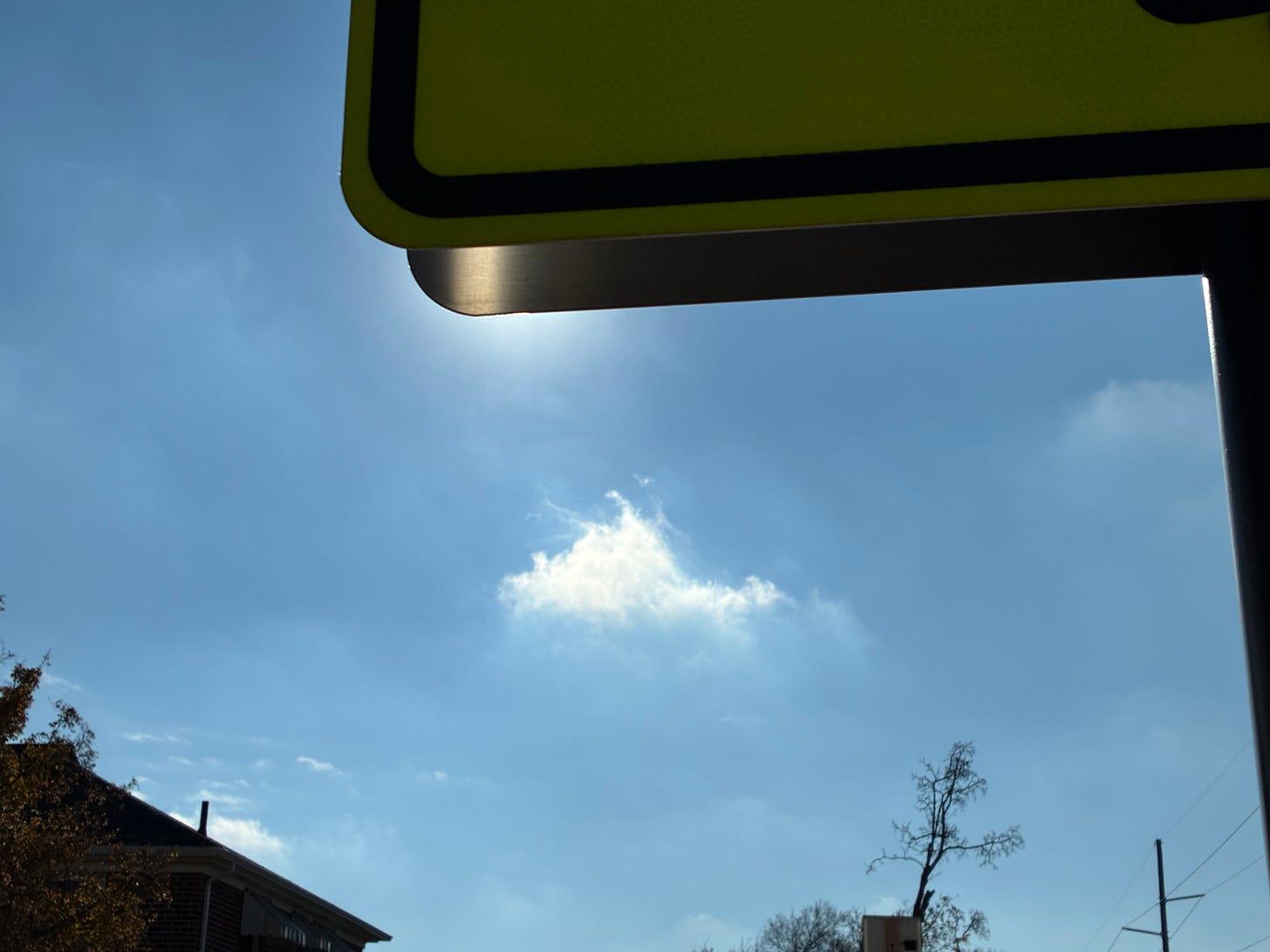
If you look closely at the blue sky, particularly adjacent to the cloud in the center, you can see blobs of haze all over. This haze is still liquid water but would normally not be considered “cloud”, because it is so difficult to see.
And when we assume this “non-cloud haze” does not exist, as is commonly done, the end result is an accounting error in Earth’s global radiation budget equivalent to an increase of 75ppm of CO2, as quantified by Koren and coauthors in a followup study.8 In other words, when we assume clouds are binary, we could be over- or underestimating the amount of global warming by ~25%! Another recent study (Sokol 2024) found that treating high clouds as a continuous field, rather than discrete objects, adjusted the overall estimate of the expected amount of warming per unit CO2 increase by 0.3° C. Even worse, these two studies each considered a different type of cloud (low vs. high, respectively), implying that we could be making both of these errors at the same time!
So the scientific community is gradually realizing that the common binary approach to clouds is not sufficient for the questions we want to answer. I think it’s important for us to further realize that a continuous approach to clouds is also incompatible with the idea of clouds as entities. If we fully change our conceptual view from discrete to continuous, it no longer makes sense to ask about cloud life cycles. For something to have a life cycle at all, it must be some type of entity that maintains identity through time. Visual intuition is not sufficient to carve up Nature into physically meaningful entities.
We should think of clouds in a similar way to how we think of the wind field. Each point in the atmosphere has a wide range of possible values for the amount of liquid (or solid) water — just as each region has a wide range of possible values for the strength of the wind.
Why do we see clouds?
So why do we intuitively perceive the atmosphere as containing discrete clouds? As I mentioned, I think it's because we happen to be able to see them. The reason they are so visually obvious is because their reflectivity (read: whiteness) increases very abruptly with the amount of liquid water. For each region of the atmosphere, there is a vast range of possible amounts of liquid water. But the "whiteness" quickly saturates at pure white even for modest amounts of liquid water, so much of the atmosphere is either white or transparent.
Here's an example of what I mean. The below plot is from a cloud simulation,9 and it shows the amount of liquid water as a function of distance along a horizontal path through a cloud field.
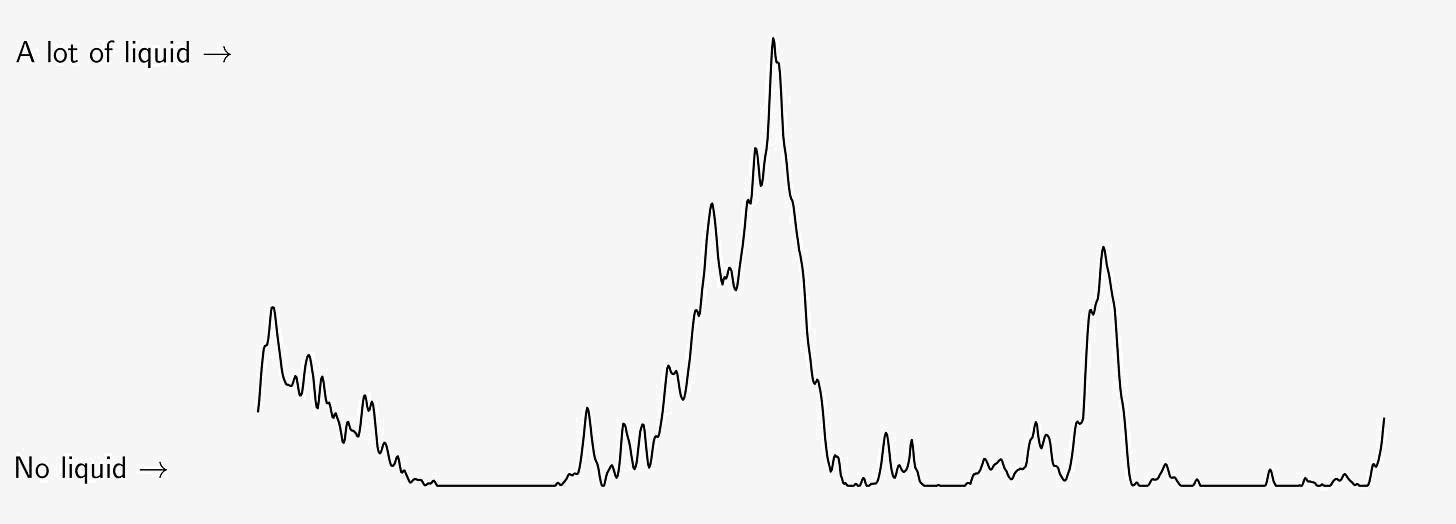
If you look at the region on the right, values of liquid water are very low, indicating a region relatively free of clouds. But near the middle, there is a spike of liquid water, indicating a relatively thick cloud.
Now, let's convert the amount of liquid water to how transparent the atmosphere would be at that location:
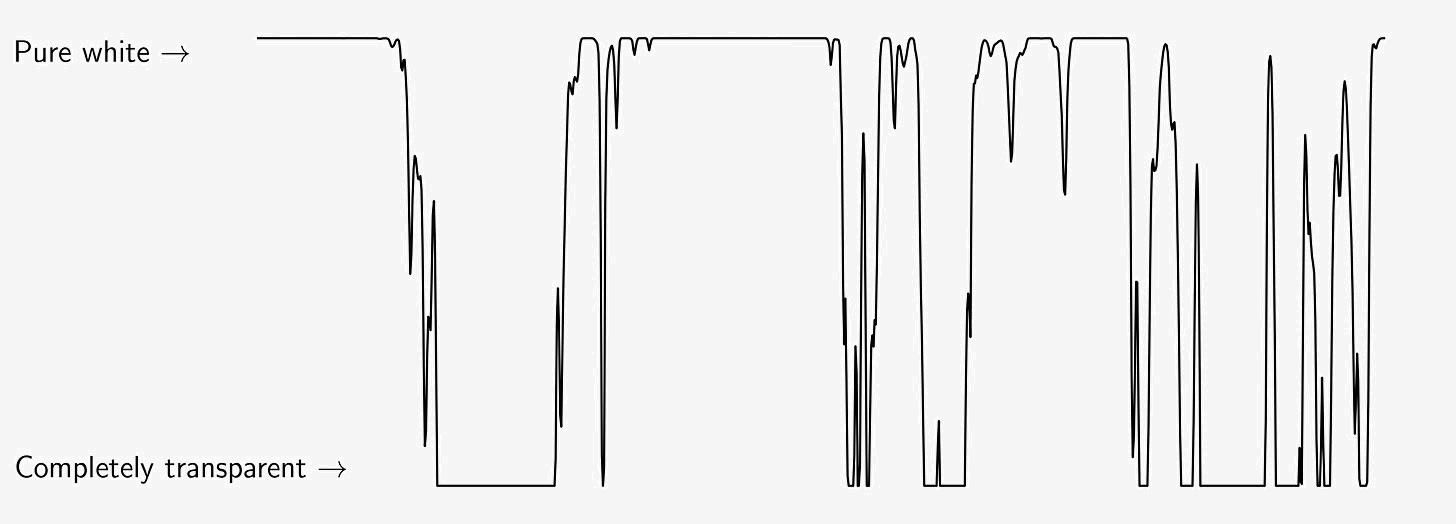
In this case, we see that most regions are either very close to completely transparent or very close to completely opaque, i.e. pure white. The region in the center hits a “ceiling” at pure white — there is much more liquid than necessary to make that region opaque. Most of the variation in liquid water content is invisible because it doesn’t get whiter than white.
For the transparency plot, we actually can closely approximate the black line with a binary version. Here, the red line, which is only ever two things ("cloudy" or "clear"), follows the black line relatively well:
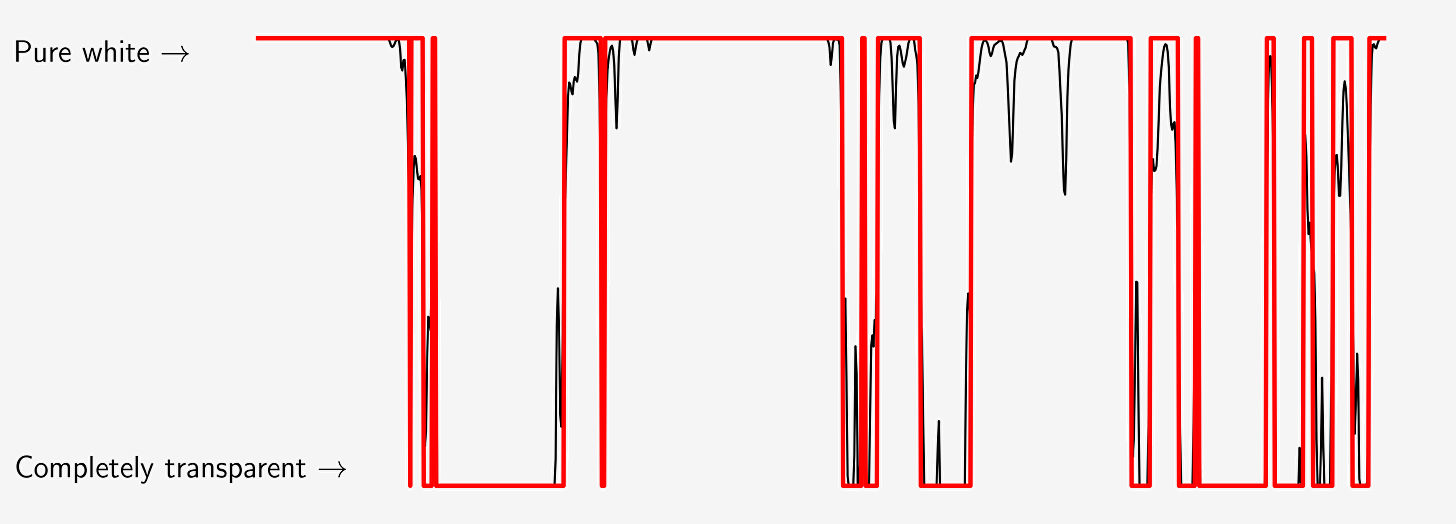
This binary approximation is far worse for the liquid water plot, because in this case the black line doesn’t hit a ceiling:
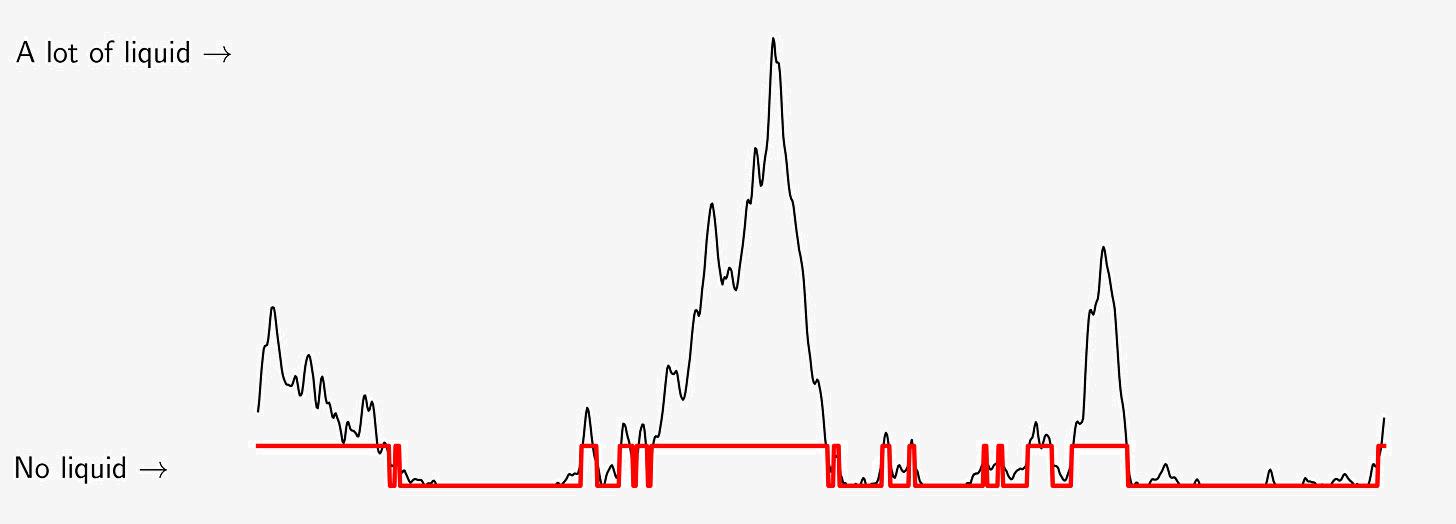
But we don’t see liquid water directly. We see reflectivity, which is often close to binary. So it makes sense that, when we look at the sky, mostly we see two things: white and blue, or opaque and transparent. In short, our eyes predispose us to using a certain (binary) mathematical approximation.
But a mathematical approximation is not the same as a physical interpretation. And as humans, we tend to ascribe a certain amount of independence, separability, or even agency to objects we see in the world. This is normally appropriate: most objects can be separated from their surroundings. I can pick up a rock, move it around, and it's the same rock. It has well-defined boundaries where mineral turns to air. But not all things are like this.
Clouds are perhaps better viewed as analogous to a moving cursor on a computer screen. Although it looks like there is an object, the cursor, that is moving, it is an illusion created by static screen pixels being cleverly turned on and off. There is no cursor "in" the screen. There is simply a sheet of pixels, some of which are a different color. Similarly, when you watch a cumulus cloud grow into a cumulonimbus, the molecules that make up the cloud are continually being replaced. The impression that the cloud maintains its identity is an illusion caused by a continual cycle of condensation, which makes a bit of air visible, and evaporation, which makes it invisible.
Clouds do not exist in the sky. They are the sky. They are simply a portion of the sky that happens to be visible.
Further Reading
The ignored lesson of cloud shape
1 This is a slight oversimplification, because the most uncertainty actually comes from the fact that we don't know exactly how much greenhouse gas humanity will emit in the future. So, more precisely, clouds are the largest uncertainty for a given emission scenario. A key reference here is Figure TS.17 in the Technical Summary of the latest IPCC Assessment Report 6.
2 This is actually only half of the story. Clouds have a huge impact because they strongly interact with thermal radiation as well as visible radiation. Next time you go camping, notice how nighttime cloud cover increases the nighttime temperature. This is because clouds emit radiation that warms the ground.
3 E.g. Craig & Cohen 2006: https://journals.ametsoc.org/view/journals/atsc/63/8/jas3709.1.xml and Garrett et. al. 2018: https://agupubs.onlinelibrary.wiley.com/doi/full/10.1029/2018JD028803
4 https://journals.ametsoc.org/view/journals/atsc/78/9/JAS-D-20-0361.1.xml
5 This is sometimes taken quite literally, e.g. Chen et. al. 2025: https://agupubs.onlinelibrary.wiley.com/doi/pdf/10.1029/2023MS003739
6 This is a reference to "cloud fraction" which is indeed a concept used to simplify cloud dynamics in climate models. It is a single number that represents what fraction of a grid box is covered by (binary) clouds.
7 https://agupubs.onlinelibrary.wiley.com/doi/epdf/10.1029/2007GL029253
8 https://www.nature.com/articles/s41561-020-0636-8
9 This is from a new type of simulation I am working on, so I'll have to punt the details to an upcoming publication. But the reflectivity calculations are standard. The simulation has 100 meter cube grid boxes, and the maximum liquid water content in the first figure is close to 1 g/kg, which is quite ordinary for a convective cloud field, e.g. cumulus congestus. The calculations are for a single transect of 100m cubes.